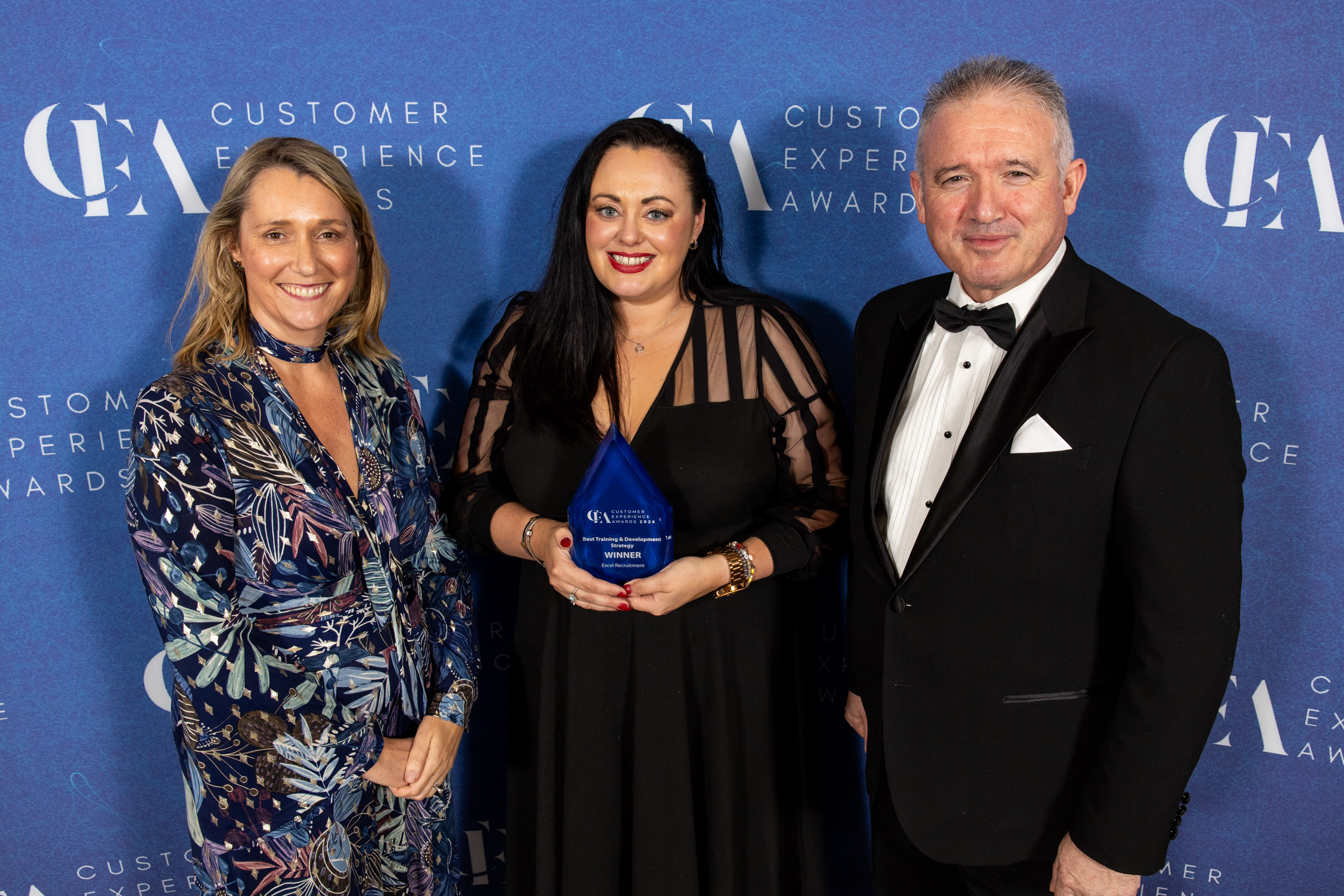
Excel Recruitment Team win Best Training & Development Strategy at the Customer Experience Awards 2026

Excel Recruitment Wins Best Training & Development Strategy at the Customer Experience Awards 2026

We are delighted to announce that Excel Recruitment has won Best Training & Development Strategy at the Customer Experience Awards 2026.

It was a fantastic evening celebrating organisations across Ireland that deliver outstanding customer experiences. We were incredibly proud to see our approach to training and development recognised.

At Excel Recruitment, investing in our people sits at the heart of what we do. We believe that giving people the right skills, support and opportunities helps them reach their full potential.

This award recognises the work our team puts into developing our people. It also reflects something we believe strongly: great customer experiences start with great people.


Investing in our people

Recruitment is a people business.

Every conversation with a candidate, every interaction with a client and every piece of advice from a consultant shapes the Excel Recruitment experience.

That makes our people one of our greatest strengths. It also makes their development incredibly important.

Training gives our teams the knowledge and skills they need to do their jobs well. It also helps them build confidence, take on new challenges and develop their careers.

As the recruitment industry changes, our people need to keep learning. This could mean developing specialist recruitment knowledge, improving communication skills or learning how to use new technology.

Our goal is simple. We want to give our people the tools they need to succeed.


Development does not stop after onboarding

Training should not end when someone finishes their first few weeks.

Starting a new role comes with plenty to learn. There are systems to understand, industries to learn about and relationships to build with candidates and clients.

However, development needs to continue long after the initial onboarding period.

Our people need opportunities to learn from experienced colleagues and take on new responsibilities. They also need to see where their career could take them.

Progression does not always mean moving into management. For some people, it may mean developing specialist knowledge. For others, it could mean taking on more responsibility, mentoring colleagues or moving into a new area of recruitment.

A strong training and development strategy needs to support all of these paths.


Building careers at Excel Recruitment

This approach reflects the work we do with candidates every day.

At Excel Recruitment, we help people make informed decisions about their careers. We talk to candidates about their experience, their goals and what they want from their next move.believe our own people deserve the same level of support and want our employees to build careers with Excel Recruitment, not simply fill a role.

That means creating opportunities to learn, develop and progress. It also means giving people the support they need at different stages of their careers.

Everyone learns differently. Some people thrive through formal training, while others develop through mentoring, experience and new challenges.

Our training and development approach needs to recognise those differences.


Great customer experiences start with our people

Winning Best Training & Development Strategy at the Customer Experience Awards 2026 is a fantastic achievement for Excel Recruitment.

More importantly, it recognises the work and dedication of our team.

Training and development has a direct impact on the experience we provide to candidates and clients. When our people feel confident and supported, they are better equipped to provide the service our customers expect.

A candidate may remember the consultant who took the time to understand their career goals.

A client may remember the recruiter who took the time to understand their business and provide honest advice.

These experiences matter.

They are created by people who have the knowledge, confidence and support to do their jobs well.


Looking ahead

We’re incredibly proud of this award and everyone who has contributed to our training and development journey.

We’d like to thank our team for their hard work and commitment. We’d also like to congratulate all of the finalists and winners at this year’s Customer Experience Awards.

For Excel Recruitment, this award is another reason to keep investing in our people.

We’ll continue to develop skills, build careers and create opportunities for our teams to reach their full potential.

Our role is to help you Excel.

The second first impression

The Second First Impression

Our Director of Grocery Retail Recruitment, Nikki Murran, featured in the latest edition of ShelfLife Magazine to discuss the importance of making a good impression to convince your new employee to stay. Check out what she had to say below!

We talk a lot about how difficult it is to recruit good people into grocery retail. We talk about candidate shortages, salaries, working hours and how hard it is to get somebody to accept an offer. Then, when they finally say yes, everyone breathes a sigh of relief and moves on to the next vacancy.

The problem is that accepting the job is only half the battle. The next challenge is getting them to stay. Their first impression of the business from the interview may have gone well, but their second first impression starts on their first day! Arguably this one is even more important.

Research from BambooHR suggests employers have around 44 days to convince a new employee that they have made the right decision. To be honest, in retail, it can take considerably less than 44 days to convince them they have made the wrong one.

First impressions

A poor first day can do plenty of damage. The manager was not expecting them, there is no uniform ready, nobody knows who is training them and their clock in or till login details have not been set up. They spend the first hour standing awkwardly beside the customer service desk while somebody tries to figure out what to do with them.

It may sound like a small thing, but first impressions matter. Candidates are judging a business just as much after accepting the job as they were during the interview.

Good onboarding really starts before the employee arrives. It begins with an accurate job description and an honest interview. If the role involves early starts, late finishes, weekends or regular duty-management cover, say so. Overselling the position might get somebody through the door, but it will not keep them there.

I regularly speak to candidates who leave roles within the first few months because the job turned out to be completely different from the one discussed at interview. Sometimes the responsibilities are different. Sometimes the hours bear no resemblance to what was agreed. In other cases, the promised training simply never happens.

Keep in touch

Once the offer is accepted, keep in touch. Candidates serving four weeks’ notice can easily feel forgotten, particularly when their current employer is trying to convince them to stay. A quick call from the hiring manager to say they are looking forward to having them join can make a bigger difference than you might think.

It is also worth sending the practical information in advance. Where should they park? Who should they ask for? What should they wear? What time will they finish on the first day? New starters do not want to chase these details, and nobody wants to arrive for their first shift already feeling like a nuisance.

When they do arrive, have a plan. It does not need to be anything fancy, but somebody should be expecting them and should take responsibility for showing them around. Introduce them to the team, explain how the store operates and give them a proper idea of what their first week will look like.

Assigning a buddy can work particularly well in grocery retail. Managers are pulled in every direction and may not always be available to answer every question. An experienced, approachable colleague can help the new starter learn the everyday things that rarely appear in a handbook, from where stock is kept to who has a habit of disappearing when the tills get busy.

Training day

Training is another area where good intentions often fall apart. Telling somebody to follow Mary for a few days is not really a training plan, especially if Mary has not been told.

Set out what the employee needs to learn in their first week, first month and first three months. Cover the obvious areas such as systems, procedures, health and safety and food hygiene, but also spend time on the standards that matter to your particular store. It’s fine for this learning to be self-driven – allow them to take come control and responsibility for getting through the areas – but the plan needs to come from the employer.

This is especially important for managers. An experienced department or store manager may understand retail, but they still need to understand your business. They need to know what authority they have, what the immediate priorities are and where the challenges sit within the team. Experience can shorten the learning curve, but it does not remove it.

Check in

Regular check-ins are also important. These do not have to be formal meetings with pages of paperwork. Ten focused minutes can be enough. Ask how they are settling in, whether the role is what they expected and if there is anything they need more support with. Crucially, listen to the answer.

Onboarding should not end after the first week either. New starters are often given plenty of attention for a few days and then largely left to get on with it. That is usually when the questions, doubts and frustrations begin to appear.

Recruitment is expensive, and replacing somebody who leaves after six weeks is frustrating for everyone involved. In many cases, the problem is not the person or even the job. It is how the move was managed.

Getting somebody to accept an offer is a great result. Making sure they are still happy they accepted it 44 days later is the real win.

Irish Grocery Retail Q! and Q2 market update

Inside Irish Grocery Retail H1 2026

Our Director of Grocery Retail Recruitment, Nikki Murran, featured in the latest edition of ShelfLife Magazine to discuss what the first half of 2026 has told us about Irish grocery retail. Check out what she had to say below!

I’ve just finished reviewing all of our statistics, market data and recruitment figures from the first half of 2026, along with the feedback my team and I have gathered from retailers and candidates across the country. Each quarter we pull everything together to see what the numbers are telling us and, more importantly, whether they match what we’re hearing every day on the ground so I can share this information with our retailers.

There were a few trends that really stood out this time, so I thought I’d use this month’s article to share some of the biggest findings and what they mean for the grocery industry as we head into the second half of the year.

One thing is clear. Grocery retail continues to prove just how resilient it is.

Take-home grocery sales are still growing, online shopping continues to gather pace and inflation has eased to its lowest level since last summer. On paper, that’s encouraging. But dig a little deeper and you can see that shoppers are still being incredibly careful with their money. They’re making more shopping trips, buying a little less each time and looking harder for value.

That’s why retailers can’t afford to become complacent. Availability, promotions, own-label ranges and strong fresh food departments are making the difference. Customers are still spending, but they’re thinking much more carefully before they do.

Big battle

The battle at the top of the market remains fascinating. Dunnes and Tesco are virtually neck and neck, while Lidl continues to gain ground and online grocery has now become a €253 million part of the market. It’s another reminder that retailers are no longer managing just one shopping experience. They have to get both the physical store and online offering right, and neither can come at the expense of the other.

From a recruitment perspective, the market has been just as interesting. The biggest surprise for me has been the increase in senior hiring. We haven’t seen demand like this for experienced store managers, general managers and area managers in well over five years. Retailers aren’t just looking for people to keep the lights on. They’re investing in leaders who can improve commercial performance while building engaged, motivated teams.

Fresh food continues to be the biggest challenge, and that doesn’t look like it’s changing anytime soon. Every week we’re working on roles for deli managers, bakery managers, butchers and fresh food specialists, and the same issue keeps coming up. The best candidates aren’t actively applying for jobs. They’re already employed, they’re valued by their current employer and they’ll only move if the opportunity genuinely improves their career. That’s why businesses that move quickly almost always have the advantage.

What candidates want

One of the biggest changes I’ve noticed over the past couple of years is what candidates actually want.

Salary still matters, of course, and continued increases in the National Minimum Wage (NMW) have pushed expectations higher across almost every level of retail. But pay is no longer the whole conversation. Candidates want flexibility, supportive managers, career progression and a realistic work-life balance. They also want honesty. Telling someone they’re joining a ‘fast-paced environment’ isn’t exactly a unique selling point. Every grocery retailer in Ireland is fast-paced. Tell candidates what genuinely makes your business different instead.

We’re also seeing employers becoming much more deliberate with recruitment. Every hire has to justify itself, and interviews are becoming more thorough. Interestingly though, our own recruitment data shows the average time to hire has fallen from eight weeks to six. That’s not because the market has become easier. It’s because employers have realised that if they hesitate, somebody else will hire the candidate first.

If I had to pick one message from the first half of the year, it would be this: retention is becoming every bit as important as recruitment. Replacing experienced grocery managers is expensive, disruptive and time-consuming. By the time recruitment fees, onboarding, training and lost productivity are factored in, replacing one experienced manager can cost up to 30% of their annual salary. That’s a huge investment compared to retaining someone who’s already performing well.

Looking ahead

Looking ahead, I don’t see the second half of 2026 bringing any dramatic changes. Value will continue to drive customer behaviour, fresh food will remain one of the biggest competitive advantages retailers have, online shopping will keep growing and experienced leaders will continue to be in demand.

The retailers that will come out strongest won’t necessarily be the ones paying the highest salaries. They’ll be the businesses investing in good leadership, creating positive cultures, giving people genuine opportunities to progress and making decisions quickly when great talent becomes available.

After spending the last six months speaking with retailers and candidates across the country, that’s probably the biggest takeaway of all. Grocery retail has always been a people business, and despite everything that’s changing around it, that still hasn’t changed one bit.

AI in recruitment

The Smart Way To Use AI In Retail Recruitment

I’ll admit it. I’m obsessed with Artificial Intelligence (AI). I’ve done every course I can get my hands on. I’ve tested more AI tools than I care to admit, and our business has invested heavily in both the technology and the training to make sure we’re getting the most out of it.

It’s brilliant. But here’s the thing…

Despite all the hype, there still isn’t an AI tool on the market that can walk into a store, meet a manager for ten minutes and instinctively understand the culture they’ve built. It can’t tell when someone says they want “a strong assistant manager” but actually means they need someone calm who’ll steady the ship after a difficult few months.

It also can’t sit across from a candidate and spot that they’re not really leaving because of salary. They’re leaving because they’ve stopped learning. Or because they’re exhausted. Or because they simply don’t click with their manager anymore.

Those are human conversations. Retail is still a people business, and recruitment is still about people. Where AI does shine is taking care of the jobs that don’t need your brainpower, so you can spend more time on the ones that do.

So, if you’re recruiting into your store, here are a few of my favourite do’s and don’ts.

Don’t let AI write your recruitment strategy. Do use it to help build your wish list.

One of my favourite tricks is incredibly simple. Open ChatGPT (or whichever AI tool you like), press the microphone button and just…talk. Describe your perfect hire exactly as you would to another manager over a coffee.

“I need someone who loves fresh food.”

“They’ve got to be calm under pressure.”

“I’d like someone who enjoys coaching younger managers.”

“The deli standards have to be second nature.”

Don’t worry about structure or grammar. Just chat. When you’re finished, ask AI to turn everything you’ve said into a professional candidate specification. You’ll be amazed how much clearer your own thinking becomes.

Don’t copy and paste a generic job description.

Every retailer has them. The same Store Manager job description that’s been sitting on a shared drive since 2018 with a few job titles changed along the way. Your store isn’t generic. Your people aren’t generic. Your next hire shouldn’t be either. Use AI to improve your job specification, not replace it. Ask it to tighten the wording, remove repetition or make it easier to read, but always leave your own personality in there.

Do let AI help write your advert.

Once you’ve created a proper candidate specification, ask AI to turn it into a job advert. Better still, tell it where you’re advertising and ask it to optimise the advert using search terms candidates are actually typing into Google or job boards. A well-written advert won’t magically solve a recruitment shortage, but it will make sure the right people actually find your vacancy.

Do use AI as a second pair of eyes.

I still believe interview questions should come from the hiring manager. However, AI is brilliant for checking you’ve covered everything that mattered in your original job specification. One tip I use regularly is after an interview, dictate your notes into your AI tool and ask it to produce a concise interview summary. Instead of pages of handwritten scribbles, you’ll have clear interview notes for every candidate, making it much easier when you’re comparing your shortlist later.

 Don’t forget about GDPR.

This one matters. If you’re using a free AI platform, think twice before uploading CVs, contracts or personal information. Make sure you’re using an appropriate, secure and GDPR-compliant platform before sharing anything confidential. It’s a fantastic assistant, but it still needs sensible boundaries.

Do freshen up your paperwork.

I’ve seen plenty of retailers still using contracts, policies and documents that haven’t had a proper review in years. AI won’t replace legal advice, but it can absolutely help modernise wording, improve clarity and highlight areas you may have overlooked before your solicitor reviews the final version. Think of it as a really efficient first draft.

Don’t automate the moments that matter.

This is probably my biggest one. Yes, AI can write an offer letter. Should it? Probably not. The best offer letters explain why you’ve chosen that person. Why you think they’ll fit your team. Why you’re excited about what they’ll bring. That’s personal. The same goes for offering someone a job. A phone call will always beat an email. Always. Candidates remember how you made them feel long after they’ve forgotten what the contract said. That’s something no chatbot has managed to master yet.

AI is changing recruitment, and I’d encourage every retailer to embrace it. Used well, it can save hours every week, improve consistency and remove a lot of admin. Just don’t confuse efficiency with connection. Use AI to give yourself more time to meet people, not less. Because at the end of the day, recruitment isn’t about finding CVs. It’s about finding people. And thankfully, that’s still something humans are pretty good at.

careers

A Changing Conversation Around Careers

Nikki Murran asks is grocery retail becoming an attractive career again?

A few weeks ago, I was chatting with one of my aunts about my cousins. I have always been ridiculously impressed by them. Between them, they work in finance, technology and other highly specialised sectors. If you had asked me ten years ago which careers were the safest and most future proof, those industries would probably have topped the list.

What surprised me was hearing how much uncertainty there now is for graduates entering those sectors.

Our conversation quickly turned to AI and the impact it is already having on entry-level roles. While experienced professionals are adapting, there is growing discussion around what graduate programmes and junior positions in finance, accounting and technology will even look like over the next few years.

Driving home afterwards, I found myself thinking about grocery retail and how different the conversation feels in our industry.

I have always believed grocery retail is one of the best industries in Ireland to build a career in. It is why I have dedicated more than two decades of my life to the sector. What is nice to see now is that the facts are starting to back up what many of us working in the industry have known for years.

The numbers are starting to tell the story

Back in 2016, store managers in symbol supermarkets typically earned between €38,000 and €50,000. Today, store managers in small and medium supermarkets are commonly earning between €50,000 and €65,000, while experienced managers in larger supermarkets can earn up to €120,000 depending on the size and complexity of the operation.

Trainee managers have seen even more significant movement. In 2016, many trainee roles sat between €21,000 and €26,000. Today, those same positions are often attracting salaries of €35,000 to €36,000.

When you compare those increases against Irish inflation of approximately 20% over the same period, it becomes clear that many grocery retail management salaries have grown well ahead of the cost of living. Fresh food managers, store managers and trainee managers have all seen salary growth that comfortably surpassed inflation over the last decade.

The overall package has changed

The pay improvements are great to see, but what has always made this industry special goes beyond salary.

What has changed massively over the last decade is the overall package being offered to managers and retail teams.

Hours and work-life balance have improved in many businesses. Training is far more structured and accessible. There is a much bigger focus on soft skills, leadership and people management than there used to be, which is long overdue in an industry built around people.

Career paths are also far more transparent. In the past, progression could sometimes depend on who trained you or whether somebody happened to spot your potential. Now, many retailers have clear development plans in place and progression is much more closely linked to performance, attitude and hard work.

Bonuses and incentives have improved too, with many retailers rewarding managers directly for strong store performance, standards and team results.

There is also far more autonomy in modern retail management roles than people realise. Great managers are often given real ownership over their stores, their teams and the culture they want to create.

Perhaps the biggest shift of all, though, is culture.

Retailers are putting far more emphasis on creating positive working environments, supporting teams properly and developing leaders who can motivate and coach people well. There is still work to do, of course, but the difference compared to a decade ago is huge.

Grocery retail still needs people

There is also the security that comes with grocery retail.

While many sectors are questioning what AI might mean for their workforce, grocery retail remains rooted in people. Stores still need leaders. Teams still need coaching. Customers still need service. Products still need to be ordered, merchandised, prepared and sold.

Technology will absolutely change parts of retail, just as it will change every industry, but I struggle to see a future where great retailers do not need great people.

I also think people underestimate how enjoyable retail can be when you genuinely like working with people.

No two days are ever the same. You could walk into a store with a full plan for your day and within ten minutes something changes. A delivery arrives late, a team member calls in sick, a customer needs help or somebody accidentally burns half the breakfast pastries before 8am.

For the right personality, that unpredictability is actually part of the appeal. You are constantly interacting with people and constantly solving problems. You build genuine relationships with customers and teams over time, and that sense of community is something many industries simply cannot offer in the same way.

Ireland is leading the way

The continued growth of fresh food and convenience retail has also transformed the industry over the last decade. Irish retailers are now recognised among the best in Europe for fresh food standards, innovation and customer experience. From bakery and deli operations to food-to-go concepts and specialist departments, there are more career paths available in grocery retail today than ever before.

No industry is completely future-proof, and retail will continue to evolve like every other sector.

But for people looking for a career with progression, stability, strong earning potential and plenty of variety, grocery retail has a lot going for it.

Maybe more than ever before.

AI in recruitment

AI in Recruitment: Raising Standards, Not Replacing Recruiters

Shane McLave explains why AI can play a positive role in recruitment but why the role of the recruiter is as important as ever.

With the rapid advances in AI, do you think it will change the way we recruit in the hospitality industry?

Yes — AI is already changing recruitment and hospitality should move with it. Candidates are using tools like ChatGPT, Gemini and Copilot to refine CVs and applications; a growing share are now AI-edited. That is not inherently negative — proofreading and clearer writing help everyone. The risk is that profiles can read more senior or more technical than the person really is, and large volumes of applications can look “perfect” on paper. As a result, the brief and the assessment process matter more than ever.

That’s why strong hiring fundamentals matter — structured, competency-based interviews, practical scenarios and follow-ups that test real experience. Verification also cannot be an afterthought. AI makes it easier to create convincing references, qualifications — or even ID — so right-to-work checks, reference validation and qualification checks protect clients, teams and guests.

Has AI changed the way Excel Recruitment does business?

Yes and no. For over three years we have introduced AI and automation where it genuinely improves speed, accuracy and service. One example is timesheets. We have moved from paper timesheets for one-off shifts and spreadsheets for group bookings to fully online timesheets, improving security and providing a clearer audit trail. Over time, it can highlight patterns such as repeated overtime, peak pressure points or absence trends. As always, data quality matters — better inputs produce better insights.

Do you use AI when recruiting permanent position for clients? 

Yes. AI is particularly useful on permanent searches where the brief is specific — mandatory qualifications, technical skills, leadership behaviours or experience in certain standards and environments. We can interrogate our database of over 200,000 candidates using clear criteria and sensible exclusions to produce a relevant longlist quickly.

That speed means our consultants can spend more time speaking with people, validating fit and assessing capability in a structured way — shifting the focus from a polished CV to evidenced skills and outcomes.

Where do you see AI adding the most value in hospitality recruitment over the next 12-24 months?

The biggest gains will come from removing friction across the hiring journey. On the client side, AI can help turn a hiring need into a clearer brief — tightening salaries, standardising skill requirements and ensuring essentials like hours, location, pay structure and compliance steps are captured.

On the candidate side, it can improve communication — quick acknowledgements, interview scheduling and clearer timelines and next steps.

Beyond recruitment, AI can support onboarding and early success by sharing role-relevant policies, checklists and training refreshers and flagging where extra coaching may be needed.

Will AI replace recruiters? 

AI will not replace recruiters — but it will raise the standard of recruitment. It reduces manual administration, improves speed and consistency and frees time for what matters — relationships, understanding a client’s operation, representing their brand and guiding candidates through a professional, human process.

In hospitality, that human layer protects service quality because the right hire is not only about skills, but also standards, attitude and reliability under pressure.

Hospitality is a people business. The winning approach is using AI to enhance service — faster responses, better matching, stronger reporting — while keeping human judgement at the centre. Combine smart tools with structured interviewing, robust verification and clear guardrails around fairness and privacy and you can hire with more confidence and build teams that deliver outstanding experiences.

What Sets Great Retailers Apart?

What Sets Great Retailers Apart? Lessons from Ireland’s Top Grocery Leaders

Nikki Murran, Director of Grocery Retail Recruitment, reflects on how judging the recent Grocery Management Awards was a reminder of just how much talent exists across Irish grocery retail, and discusses the people, passion and customer focus that set leading retailers apart.

Listening to some of the country’s top retailers speak about their stores, teams and communities was genuinely inspiring. Across every category, from convenience and forecourt to supermarket and discount retail, one thing became very clear: the best store managers are rarely successful by accident. It also raised an interesting question. What is it that separates good retailers from exceptional ones? What common traits appear again and again among the very best operators in the country?

Future Leaders

While every retailer had their own personality and management style, several characteristics consistently stood out. For employers trying to identify future leaders, these are the qualities worth watching for. The first, and probably most important, is that great retailers are obsessed with people. They are obsessed in a real and authentic sense. The strongest store managers are invested in the people around them. They care about their teams, they want to see people develop and create environments where staff feel supported and valued. As a result, they get buy-in. Teams work harder for managers who care about them. The best retailers understand that strong cultures create stronger stores. They know happy, engaged teams tend to deliver better standards, better customer experiences and ultimately better commercial performance. That same focus extends beyond their own staff. Top retailers are deeply connected to their customers and communities. They listen, they notice trends and they understand what their customers want from their local store. They also build relationships naturally, whether that’s with suppliers, neighbouring businesses or regular shoppers who call in everyday. At its core, grocery retail is still very much a people business.

Belief

Another trait that consistently stood out was belief. The strongest store managers believe in their store, their team and their brand. They take pride in what their business represents locally, and they see their stores as more than simply a place to sell groceries. That confidence matters. You can feel it when you walk into well-run stores. Standards are high because expectations are high. Teams buy into the culture because management buy into it first.

Community Involvement 

Community involvement was another major common denominator. Nearly every top-performing retailer spoke passionately about their local area and the importance of giving something back. Whether it’s sponsoring local sports teams, supporting school raffles, organising charity events or simply helping local causes, the best retailers understand the value of community connection. They never take customer loyalty for granted. Regardless of whether it’s a convenience shop, a supermarket or a discount retailer, the strongest store managers position themselves as part of the local community. Customers know them, trust them and associate them with the store itself.

Passion

Passion was another recurring theme. The best retailers still genuinely love the industry. They are passionate about developing people, passionate about fresh food and passionate about delivering consistency and high standards every single day. You can hear it when they speak. Their enthusiasm lifts their teams and creates positive cultures within their stores. Retail can be demanding and fast-paced, but the strongest operators still speak about it with energy and pride.

Customer Service

And finally, there is customer service. While people and relationships are central to great retailing, the customer remains at the centre of every decision strong store managers make. For the best retailers, customer service is not a KPI or a department. It is the foundation of the business. Every decision, from staffing levels to store presentation, is made with the customer experience in mind. In a market where customers have more choice than ever, consistency and service are often what keep people coming back. And perhaps that is the real takeaway from meeting some of the country’s best retailers. Exceptional store managers are not just operationally strong. They lead with people, belief, passion, community and customer focus. The commercial results usually follow.